Most businesses in Omaha are overpaying for downtime. They just don’t know it yet.
You’ve probably been there: It’s 9:00 AM on a Tuesday, your team is ready to go, and the network drops. Or worse, the server hosting your critical customer data decides to take a permanent vacation. You call your "IT guy," and he says he’ll be there in two hours.
That’s the "Break-Fix" trap. It’s reactive. It’s expensive. And in 2026, it’s a recipe for operational failure.
If you’re running a business in the Midwest: whether it’s a manufacturing plant in Lincoln or a busy professional office in Omaha: you can’t afford to wait for things to break. You need to know they’re about to break before the screen goes black.
That’s where proactive monitoring comes in. But does it actually matter, or is it just another line item on a managed IT services contract? Let’s look at the reality of IT in 2026.
The Death of Reactive IT
The old way of doing IT was simple: something breaks, you call for help, someone fixes it, and you get a bill. It sounds straightforward, but it’s a financial drain. Every minute your staff is sitting around waiting for a login screen to load is money leaking out of your business.
In 2026, technology is too integrated into our daily workflows to rely on reactive support. The end of reactive IT is here because Omaha small businesses are tired of recurring tech headaches that kill productivity.
Proactive monitoring isn’t just "watching" your computers. It’s an active, AI-driven process that identifies patterns of failure. It’s the difference between replacing a failing hard drive on a Saturday morning and walking into a total system collapse on a Monday morning.
Why 2026 is Different: AI and Predictive Analytics
We’ve moved past simple alerts. In the past, monitoring meant getting an email when a server was already down. Today, we use AI-powered predictive analytics to see the future.
Research shows that organizations using proactive monitoring can resolve about 80% of potential issues before an end-user even realizes there’s a problem. By analyzing historical performance data, modern systems can predict when a network switch is likely to fail weeks in advance.
For managed IT services in Omaha, this means we aren't just reacting to your phone calls; we’re stopping the phone call from ever needing to happen. We look at:
- Degraded performance patterns: Subtle slowdowns that signal hardware fatigue.
- Predictive disk failure: Swapping drives before the data is at risk.
- Automated remediation: AI-driven protocols that fix common software glitches without human intervention.
The Hospitality Trap: Why "Fast Support" Isn't Enough
We see this a lot with hospitality groups and medical clinics in Nebraska. They focus on how fast an MSP responds to a ticket. While a fast response is good, it’s actually a trap.
If your IT provider is "fast" at fixing the same problem every month, you don’t have a support problem: you have an infrastructure problem. True managed IT services in Omaha should focus on uptime, not just how quickly they can put out the fire they should have prevented.
In 2026, proactive monitoring is the only way to escape the cycle of "broken-fixed-broken."

Convergence: Where Physical Security Meets IT Infrastructure
One of the biggest shifts we’ve seen is the convergence of physical security and traditional IT. Your door access control, your CCTV cameras, and your network are now one single ecosystem.
If your network is shaky, your security cameras fail. If your server is unpatched, your access control system becomes a backdoor for hackers. This is why we advocate for a single point of accountability.
When you look for managed IT services in Lincoln NE, you should be looking for a partner who understands that proactive monitoring extends to your physical hardware.
- Are your cameras recording?
- Is your access control database backed up?
- Is your network infrastructure robust enough to handle high-def video traffic?
We handle it all under one roof. One vendor. One system owner. One point of accountability.
The Real ROI of Uptime for Nebraska Businesses
Let’s talk numbers. For a professional office or a manufacturing facility, downtime isn't just "annoying." It’s a calculated loss. If you have 20 employees earning an average of $30/hour, one hour of total downtime costs you $600 in wages alone: not counting lost revenue, missed deadlines, or frustrated customers.
The real ROI of uptime comes from stabilizing your environment. When your IT is proactive, your budget becomes predictable. You trade surprise $5,000 emergency repair bills for a flat-rate monthly investment that keeps everything running.

How SAINT Technology Services Solves This
At SAINT, we don’t do "generic IT." We are a veteran-owned, Midwest-rooted team that treats your infrastructure like a mission-critical operation. We don’t wait for you to tell us something is wrong.
We implement a three-stage process for every client:
- Assess: We expose the gaps in your current setup: from old routers to unpatched security holes.
- Stabilize: We fix the foundation. This often means moving toward an integrated system where your network and security work together.
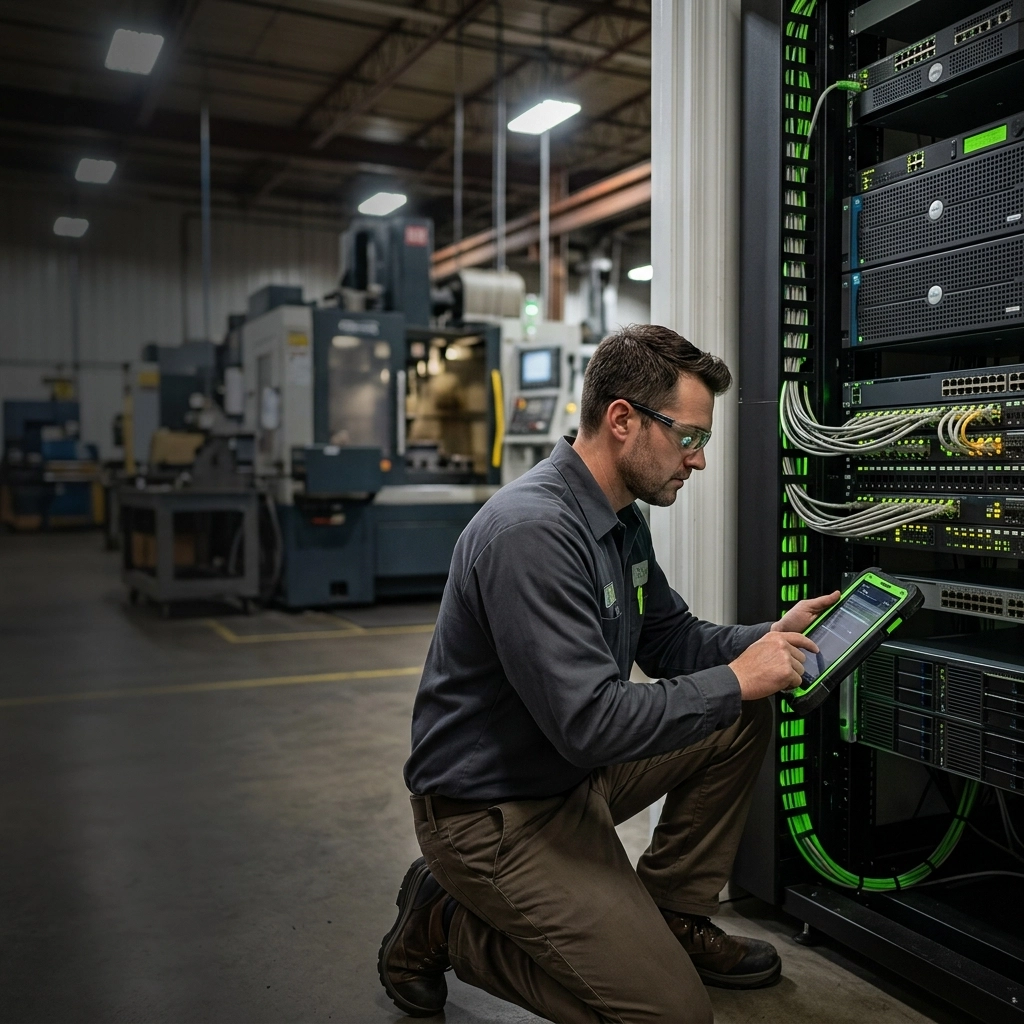
- Manage: We deploy our 24/7 proactive monitoring suite to catch issues in real-time.
We provide a direct, no-nonsense approach. No corporate buzzwords. No hidden fees. Just stable, secure technology that lets you focus on your business.
Related Services
- Proactive Network Management: 24/7 oversight of your switches, firewalls, and Wi-Fi.
- Converged Security: Integration of CCTV, access control, and cybersecurity.
- Flat-Rate Managed IT: Predictable costs with no surprise invoices.
Serving Businesses in the Midwest
We provide expert Managed IT Services in the Midwest, supporting growth-minded companies from Omaha to Lincoln and beyond. Whether you're a clinic needing Cybersecurity Services in Nebraska or a manufacturing plant looking to stabilize your infrastructure, we have the local expertise to help.
FAQ: Proactive Monitoring in 2026
Why is my network always slow on Monday mornings?
Usually, this is because systems are trying to catch up on updates or backups that failed over the weekend. Proactive monitoring catches these failures on Saturday, so they are fixed before your team walks in on Monday.
How does proactive monitoring improve cybersecurity?
Most cyberattacks, like ransomware, don’t happen instantly. Hackers often sit in a network for days or weeks. Proactive monitoring looks for abnormal behavior: like a user logging in from a different country or massive data transfers at 3:00 AM: and shuts it down immediately.
Is proactive IT support more expensive than break-fix?
Initially, the monthly fee might look higher than "zero" (when nothing is broken). However, when you factor in the cost of downtime, emergency repair rates, and lost productivity, proactive managed IT is significantly cheaper over the long run.
Can you monitor my security cameras and door locks too?
Yes. In 2026, these are network devices. We monitor the health of your physical security hardware to ensure that when you need to pull footage or unlock a door, the system actually works.
Do I need a local IT provider in Omaha or Lincoln?
While some things can be done remotely, having a local team that can be on-site for hardware failures or infrastructure upgrades is critical. We are Midwest-based and understand the specific needs of Nebraska businesses.
What happens if the monitoring software misses something?
No system is 100% perfect, but our veteran-led team provides a second layer of human oversight. If an alert is triggered, our helpdesk is on it immediately. Our goal is to fix it before you even know it was a problem.
If your business in the Midwest United States is dealing with slow systems, downtime, or unreliable IT support : SAINT fixes it before it becomes a problem.
Contact SAINT Technology Services today to schedule your infrastructure assessment. Let's stop reacting and start growing.